
If you’re developing a kidswear line for the U.S. market, one of the first questions is, “What certification do I need?” The answer starts with the garment. A printed T-shirt, a hooded jacket, and children’s pajamas can require different reviews, even when the same factory makes them.
As a U.S.-based children’s clothing manufacturer with more than a decade of experience, we are familiar with U.S. children’s apparel regulations and how they affect product design, fabric selection, testing, and labeling.
The requirements to sell children’s clothing in the U.S. depend on the intended age, product use, fabric, prints, trims, manufacturing location, and responsible business. This guide follows those decisions from product development through testing, labels, import filing, and reorders. It focuses on federal product requirements; state product rules, business permits, and sales-channel policies need separate checks.
What Are the Requirements to Sell Children’s Clothing in the U.S.?
For a typical children’s garment, classify the product, identify its applicable safety rules, complete the required testing or document permitted testing exclusions, issue a Children’s Product Certificate (CPC), and approve tracking and textile labels. For certifiable imports, prepare the certificate data for the applicable electronic filing route.
Keep these six decisions connected:
- Product: Who will wear it, and how will it be used?
- Materials: Which fabrics, prints, coatings, and trims will be in production?
- Testing: Which rules apply, and what evidence supports compliance?
- Certificate: Which business must issue the CPC, and what must it contain?
- Labels: What must appear on the garment and packaging?
- Shipment: Which certificate version and filing details match the goods?
For certificate contents, use the current requirements in 16 CFR Part 1110. For textile disclosures, start with the FTC’s textile labeling guide.
Does Your Garment Count as a Children’s Product?
Check Age, Intended Use, and Marketing
A children’s product is designed or intended primarily for children 12 years of age or younger. CPSC considers more than a “kids” label: the manufacturer’s stated intent, presentation and advertising, how consumers commonly recognize the product, and its Age Determination Guidelines all matter. Review the size range, design, product photographs, packaging, and listing copy together.
Record the intended age and use in the product brief. If the classification is uncertain, have the actual garment and marketing plan reviewed before requesting a test package. Age and size are related, but the size numbers used in a sleepwear standard are not a substitute for the children’s-product age definition.
Separate Daywear, Sleepwear, Outerwear, and Child Care Articles
Use the following table to identify the next questions. The final test plan depends on the finished product.
| Product | Classification question | What to review next |
|---|---|---|
| Everyday T-shirt or dress | Is it ordinary daywear? | Apparel flammability, lead requirements, prints, trims, and labels |
| Infant bib | Does it facilitate feeding for a child age 3 or younger? | Child care article requirements, including applicable phthalates restrictions |
| Children’s pajamas | Do the exact size, fit, construction, and labels qualify for an infant or tight-fitting route? | The applicable sleepwear or general apparel flammability requirements |
| Hooded outerwear | Is it upper outerwear in a covered size range? | Hood, neck, waist, and bottom drawstring design, plus materials and labels |
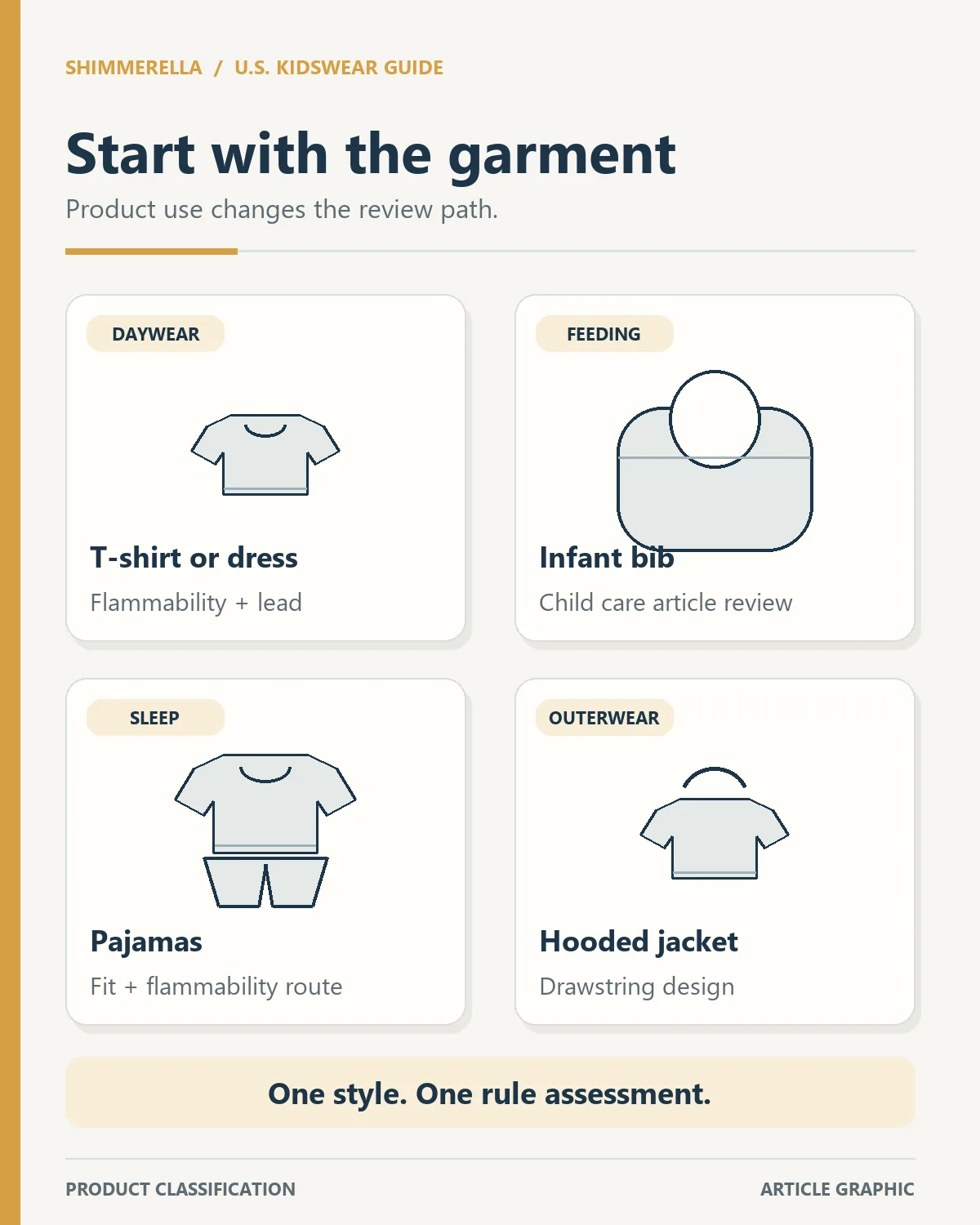
These distinctions are reflected in CPSC’s clothing guidance. A factory making all four products should still develop a separate rule assessment for each product.
Who Is Responsible for the CPC and Supporting Documents?
For a covered product manufactured overseas, the importer is the legally responsible certifier. For a U.S.-made product, the manufacturer generally issues the certificate. For a privately labeled product manufactured in the United States, the private labeler is responsible unless the manufacturer issues the certificate. These responsibilities are set out in 16 CFR §1110.7.
A factory, laboratory, or service provider may assist with documents or act on the certifier’s behalf. The responsible business retains liability for the certificate’s accuracy, completeness, and availability. A laboratory report provides evidence; it is not, by itself, the CPC.
For a typical imported kidswear order, agree on the following handoffs:
| Party | Practical responsibility |
|---|---|
| Importer / responsible certifier | Confirms the applicable rules and evidence, issues the CPC, and controls certificate data |
| Brand that is not the importer | Provides accurate age, use, design, and marketing information; coordinates label and channel requirements |
| Overseas manufacturer | Provides material specifications, representative samples, production details, label files, batch information, and change notices |
| CPSC-accepted laboratory | Tests within its accepted scope and identifies the samples, components, methods, and results covered |
| Customs broker | Coordinates the entry and agreed certificate-data transmission |
| Distributor or retailer | Obtains access to the certificate and meets its own product-safety obligations |
Confirm the legal certifier before booking the shipment. The updated importer definition generally refers to the Importer of Record, with specific provisions when a broker acts as IOR. The commercial job titles in a project do not, on their own, settle that responsibility.
Which U.S. Safety Rules Apply to Children’s Clothing?
General Apparel Flammability and Testing Exceptions
The general clothing-textile flammability standard is 16 CFR Part 1610. Vinyl plastic film used in apparel, including some rainwear, can also fall under Part 1611. Children’s sleepwear has additional classification requirements discussed below.
Under 16 CFR §1610.1(d), testing exceptions include:
- Plain-surface fabrics weighing at least 88.2 g/m² (2.6 oz/yd²), regardless of fiber content.
- Plain or raised-surface fabrics made entirely from acrylic, modacrylic, nylon, olefin, polyester, or wool, alone or in combinations of those fibers, regardless of weight.
Check both composition and construction. A predominantly polyester fabric containing cotton does not qualify under the listed-fiber exception merely because polyester is the main fiber. A raised-surface fabric does not qualify under the weight-based exception alone.
A testing exception does not remove the underlying safety requirement or automatically eliminate a CPC. Keep the applicable rule and the basis for the testing exclusion in the certification records and certificate where required.
Lead in Fabrics, Prints, and Trims
Accessible components of children’s products are subject to a 100 ppm total lead limit. Paint and similar surface coatings have a separate 90 ppm lead limit. Qualifying textiles may be covered by CPSC material determinations that remove the need for third-party total-lead testing, but a fabric determination does not automatically cover a transfer print, coated decoration, metal snap, or zipper.
Give the lab a complete bill of materials, including prints and decorative parts. Record any supplier evidence used to support a determination or component-testing approach. Reviewing the body fabric alone leaves gaps when the finished garment includes other accessible materials.
Sleepwear: Confirm the Exact Route
Under CPSC’s sleepwear guidance, children’s sleepwear that does not meet the relevant infant-garment or tight-fitting definition is subject to 16 CFR Part 1615 for sizes 0–6X or Part 1616 for sizes 7–14. Qualifying infant and tight-fitting garments remain subject to general apparel flammability requirements under Part 1610 and/or Part 1611, as applicable.
Check actual measurements, construction, size labeling, and presentation. A “snug fit” product name or an infant-size tag does not establish eligibility for an exception. Sleepwear testing can involve fabric and garment production requirements, so agree on sampling and production controls before placing the bulk order.
Phthalates, Drawstrings, and Small Parts
Phthalates: Federal restrictions apply to children’s toys and child care articles. For apparel, the relevant child care category covers articles designed or intended to facilitate sleep or feeding, or help with sucking or teething, for children age 3 or younger. CPSC includes sleepwear and bibs among its examples. Ordinary daywear is not automatically subject to the same requirements. Assess intended use and accessible components that may contain phthalates.
Drawstrings: Hood and neck drawstrings on children’s upper outerwear in sizes 2T–12 or equivalent are identified as a substantial product hazard. Waist and bottom drawstrings in sizes 2T–16 have length and construction restrictions. Resolve these issues at the design stage.
Small parts: Children’s clothing and accessories, including buttons, are excluded from the federal small-parts ban under Part 1501. Secure attachment remains an important safety consideration: specify attachment requirements and inspect trims during production.
How Do You Build the Testing File and Prepare a CPC?
Select a Lab Accepted for the Rules You Need
Check the laboratory’s accepted scope for each applicable rule in the CPSC laboratory directory. General accreditation alone does not establish acceptance for every children’s product requirement.
Send the tech pack, intended age and use, product images, size range, fabric specifications, prints, coatings, trims, and any proposed testing exclusions. Ask the lab to identify the samples and production stages needed to support the assessment. CPSC’s initial-testing guidance explains rule-specific acceptance and initial certification testing.
Match the Evidence to the Production Version
Before testing, answer one question: Which version of the garment will this evidence support?
Create a dated product record connecting the intended production version to:
- Product identifiers and the sizes or variations being assessed.
- Fabric composition, construction, weight, and suppliers.
- Print methods, coatings, trims, and component sources.
- Sample photographs, measurements, and manufacturing location.
- Relevant test reports, permitted testing exclusions, and label-artwork versions.
A blank T-shirt and the same T-shirt with a transfer print and decorative snaps may need different evidence. Compare the submitted samples with the actual production specifications before relying on a report.
Qualifying component-part evidence can support certification when the conditions, documentation, and due-care requirements are met. The certifier must understand which rules and components the evidence covers.
Check the Current CPC Content Requirements
The CPC identifies the product, the rules being certified, the responsible business, and the evidence supporting certification. Use current 16 CFR §1110.11, rather than an older seven-field template.
In the table below, full contact details means street address, city, state or province, country or administrative region, email address, and telephone number.
| Required element | Information to prepare |
|---|---|
| 1. Product identification | At least one unique identifier, such as a SKU or model number, plus a description that matches the product |
| 2. Applicable rules | Each applicable CPSC-enforced rule, ban, standard, or regulation, identified separately |
| 3. Certifier | The responsible certifier’s name and full contact details |
| 4. Records contact | The recordkeeper’s name and full contact details; a continuously staffed, responsive position title is permitted |
| 5. Manufacturing information | Manufacture date, at least month and year, plus the manufacturer’s name and full contact details; use the initial date for a production run spanning several days |
| 6. Testing information | The most recent supporting testing date and each relevant testing party’s name and full contact details |
| 7. Certifier’s attestation | The required statement affirming compliance and the truth and accuracy of the certificate information |
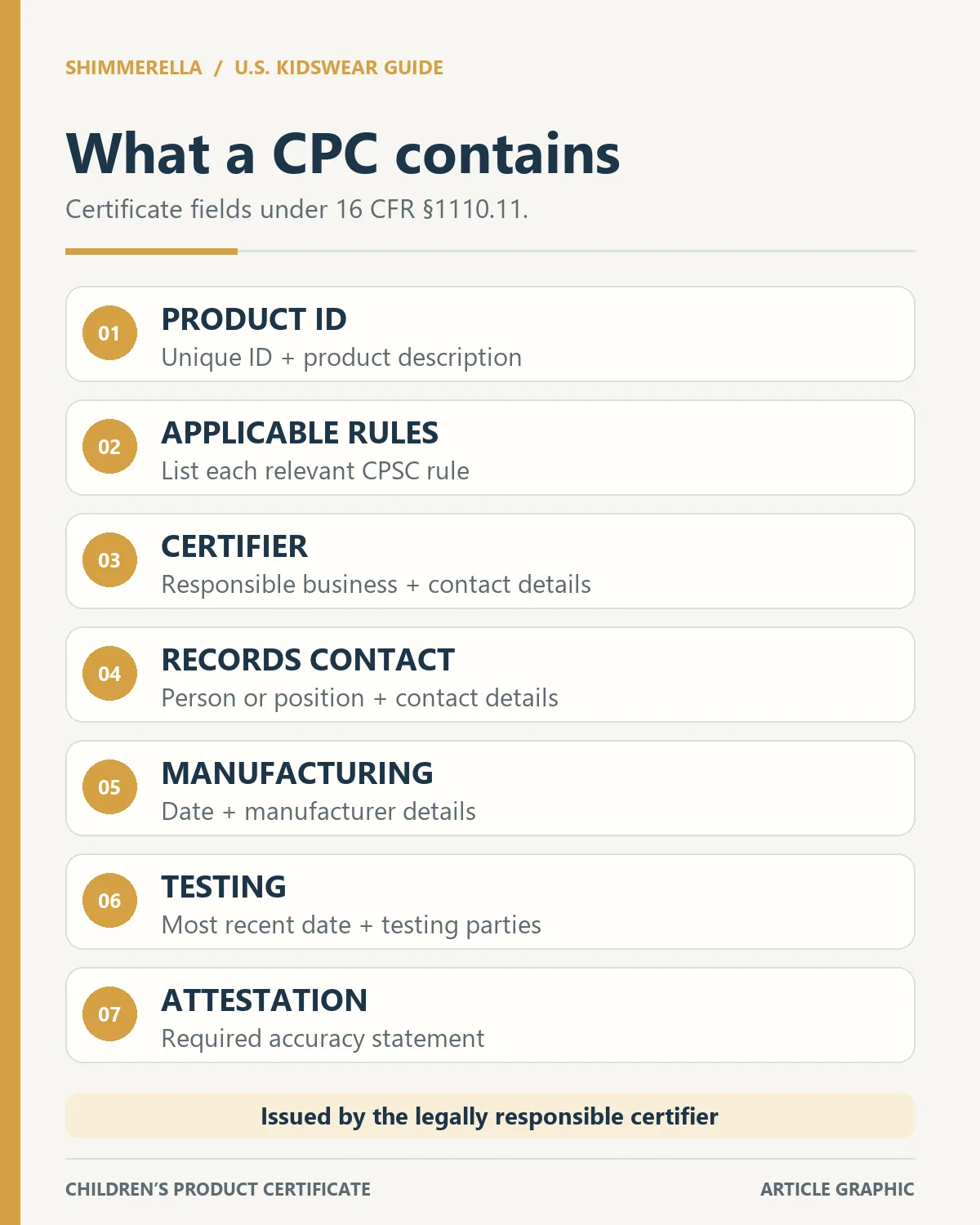
These are the current certificate-content requirements. For paper and electronic certificates, use the attestation wording prescribed in §1110.11(a)(7). For eFiled certificates, the attestation is handled through the Product Registry or PGA filing mechanism.
Where a permitted testing exclusion applies, identify its legal basis instead of supplying testing information for a test that was not required. Keep the applicable rule listed. Supporting component tests must also be represented correctly when the certificate relies on them.
Define Certificate Coverage and Access
The updated rule requires each certificate to describe one product. For apparel and footwear, CPSC explains that qualifying models tested together can be treated as one product where the differences do not affect certification and there is no material change. This does not mean every color or size automatically needs a separate CPC. Define and document the supported variations.
The CPC must be in English. Supporting records may be kept in another language if they can be supplied immediately to CPSC and accurately translated into English within 48 hours of a CPSC request, unless CPSC agrees to a longer period.
Furnish the certificate to distributors and retailers, and make the certificate available to CPSC or CBP within 24 hours of a request. Keep this certificate deadline separate from the records-translation provision.
What Labels Must Appear on the Garment and Packaging?
CPSC Tracking Information
Children’s products need visible, legible, permanent tracking marks on the product and its packaging to the extent practicable. The information must identify the manufacturer, importer, or private labeler; production location and date; and batch, run, or other identifying details. Codes can be used if the information can be retrieved and consumers know whom to contact to interpret them.
An existing suitable label may carry the tracking information. The practical test is whether a garment can be connected to its production record when a complaint arises. Tracking-label requirements are not themselves listed as a safety rule on the CPC, although other applicable rules may require that garment to have a CPC.
FTC Fiber, Origin, Business Identity, and Care Information
Most apparel needs fiber content, country of origin, and responsible business identity. For imported garments, confirm origin from manufacturing and processing records under the applicable CBP rules; the country of final finishing alone may not settle it.
Use the company’s full business name as used on invoices or purchase orders, or an appropriate Registered Identification Number (RN). An RN is optional and is issued to U.S. businesses. A brand name works as the business identifier only if it is the name under which the company does business.
For garments with a neck, the origin disclosure belongs on the front of a label at the inside center of the neck, or close to another label there. Other required textile disclosures can appear on a suitable conspicuous, accessible label.
Covered clothing also requires permanent care labeling with a reasonable basis for the instructions. Assess the whole garment, including how the fabric, print, elastic, and trims respond together. A fabric supplier’s washing recommendation may not account for a decoration added later.
Check Sleepwear Labels Separately
Qualifying tight-fitting sleepwear needs prescribed warning tags, package warnings where applicable, and the garment statement “WEAR SNUG-FITTING, NOT FLAME RESISTANT.” Check the required placement, dimensions, and formatting under 16 CFR §1615.1(o) or §1616.2(m).
Qualifying infant sleepwear has separate sizing and labeling conditions, including age-in-months size information. Review the applicable route before ordering labels; a tight-fitting warning is not a substitute for meeting the garment definition.
Prepare a Label-Approval Worksheet
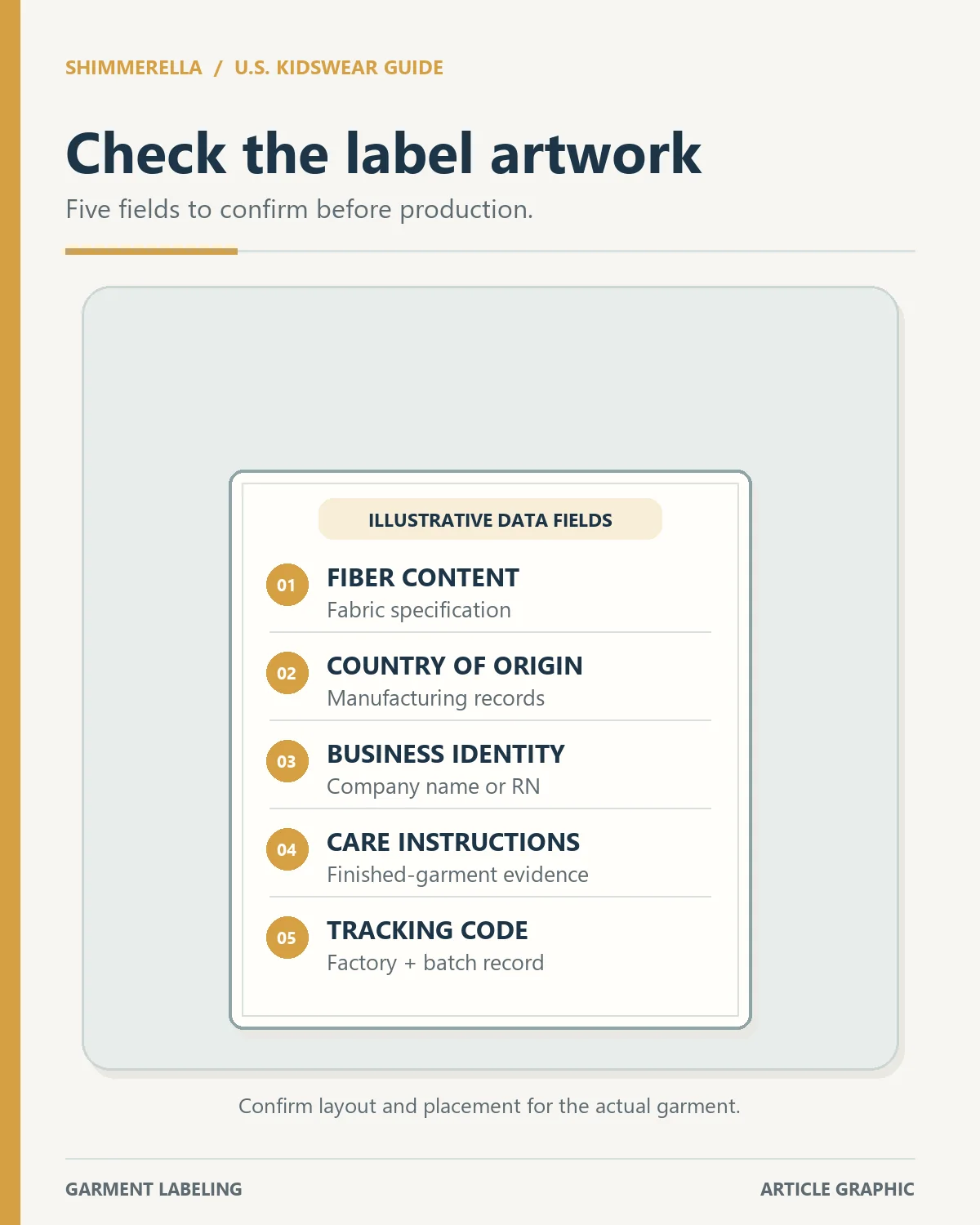
Use this worksheet to organize information for review. It is a planning aid, not an approved label for a particular product.
| Information | Evidence to collect | Approval to arrange |
|---|---|---|
| Fiber content | Final fabric specifications and supporting supplier records | Responsible brand or importer |
| Country of origin | Manufacturing and processing records, assessed under applicable CBP origin rules | Responsible brand or importer |
| Company identity | Approved business name or appropriate RN | Responsible business |
| Care instructions | Evidence supporting care of the finished garment | Responsible brand or importer |
| Tracking information | Factory, production date, and batch records | Manufacturer and responsible brand/importer |
| Special sleepwear information | Classification, measurements, and applicable labeling rules | Responsible certifier with technical input as needed |
Keep the approved artwork with the dated product record. For production, check both the printed information and the label’s actual position and attachment.
What Changed for U.S. Imports in 2026?
Certificate Updates and eFiling Dates
The revised certificate requirements apply to ordinary covered imports and domestically manufactured products from July 8, 2026. For covered products entered from a Foreign Trade Zone for consumption or warehousing, the applicable date is January 8, 2027. Domestic products do not need the import eFiling step, but their certificates must meet the updated content requirements.
For ordinary commercial imports subject to certification, the importer files the required certificate data through CBP’s Automated Commercial Environment (ACE) using a CPSC Partner Government Agency (PGA) Message Set. Coordinate it with the entry, or the combined entry and entry summary. International postal shipments and other special entry routes need their own current filing check; consult CPSC’s eFiling resources.
Choose the Full or Reference PGA Route
| Route | What the importer and broker coordinate |
|---|---|
| Full PGA Message Set | Transmit the required certificate data directly through ACE, using the current CPSC data specifications |
| Reference PGA Message Set | Store and certify the certificate data in CPSC’s Product Registry, then transmit the Certifier ID, Product ID, and Version ID through ACE to reference it |
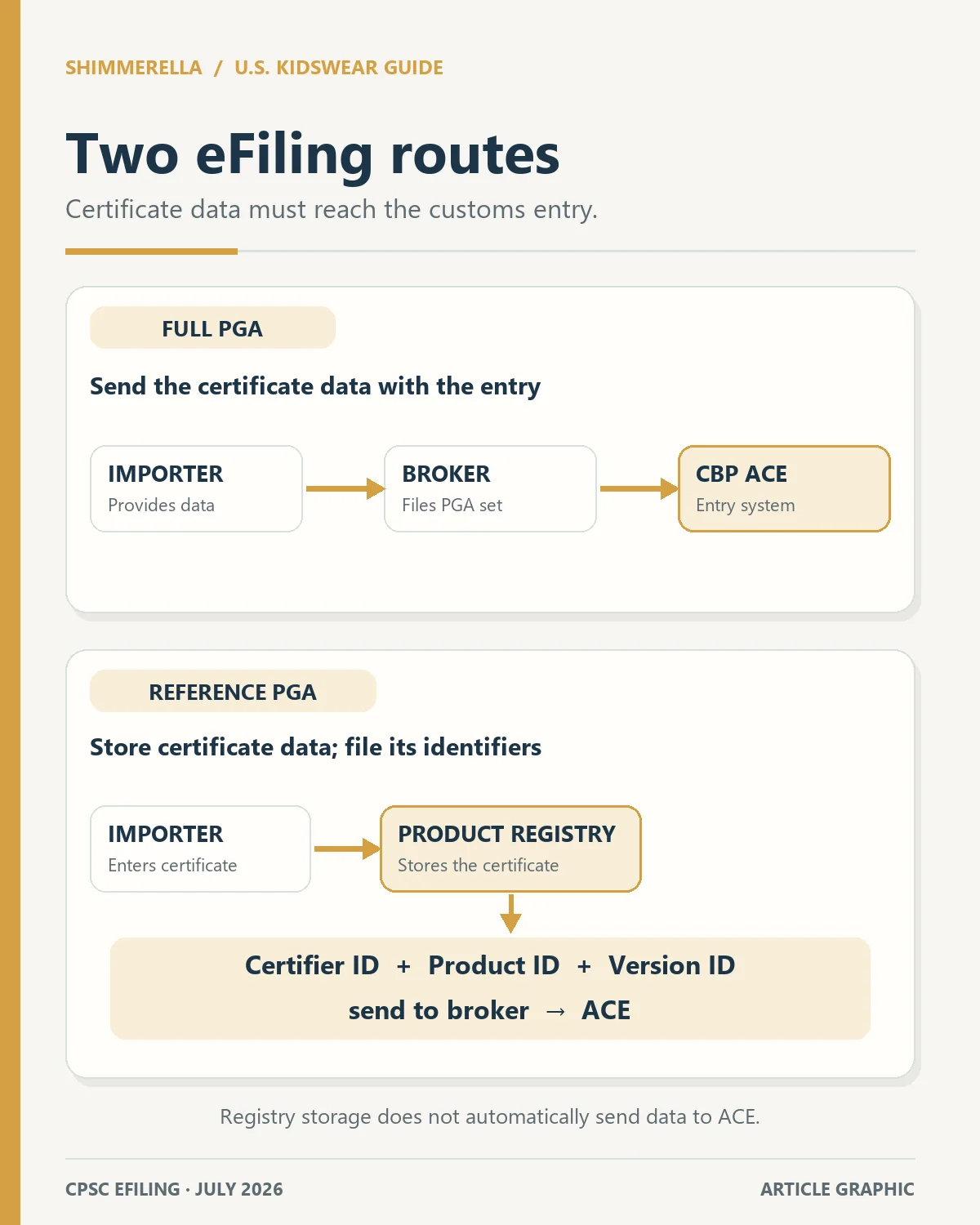
For the reference route, the Product Registry does not automatically send the data to ACE. The identifiers still need to reach the party making the entry.
Prepare the data before booking the shipment, then check that the product identifier and certificate version match the goods and shipment documents. Electronic filing does not remove the need for valid testing evidence or the certifier’s responsibility for the information.
How Do These Requirements Apply to Different Garments?
The following are illustrative planning scenarios. They explain the decisions a brand needs to make; they do not describe Shimmerella customer orders or laboratory results.
Printed Cotton T-Shirt
A cotton jersey tee with a front transfer and decorative snaps needs a review of all three elements. A testing exception or material determination for the body fabric may not cover the transfer or snaps.
Specify the production print and trim suppliers before sampling. The product record should show which evidence supports each relevant component and which finished version the CPC covers. A later transfer-supplier change should be evaluated before the next order. See Shimmerella’s kids’ T-shirt manufacturing page for product-development context.
Hooded Children’s Sweatshirt
For a sweatshirt marketed as upper outerwear in sizes 2T–12, resolve hood and neck drawstring design before approving the sample. Review any print, coated zipper pull, or decorative trim alongside the main fabric.
The production brief should identify the approved construction, component sources, and batch-information format. Confirm the garment’s classification from its actual use and marketing. Shimmerella’s kids’ jacket manufacturing page provides a starting point for an outerwear brief.
Children’s Pajamas
Start with measurements, intended age, fit, construction, and the applicable sleepwear definition. Decide which flammability route applies before buying fabric or printing a “snug fit” claim. Include the route-specific labels in the review.
Sleepwear for children age 3 or younger can also require a child care article assessment, including applicable phthalates requirements. Bring these questions into the tech pack and sample discussion. See Shimmerella’s kids’ pajamas manufacturing page.
What Must You Check Before Listing and After Launch?
State and Marketplace Requirements
Check destination-state product requirements separately from federal rules, along with the business licenses and permits relevant to your operations.
Sales channels can request CPCs, reports, label photographs, and other category documents. Confirm the current policy for the channel you use. A platform’s document request and a federal legal obligation may differ, so keep both in the launch checklist.
Material Changes, Reorders, and Periodic Testing
For each reorder, compare the new specifications with the version supporting certification. Changes to fabric, colorants, print chemistry, trims, suppliers, construction, or production processes may affect compliance. Record the change, obtain the necessary technical assessment, and update testing and certification when required.
Continued production also needs the applicable periodic-testing arrangements. There is no universal requirement to retest every size or every shipment, but using an old report requires sufficient control and evidence that it still applies. CPSC’s periodic-testing FAQ and initial-testing FAQ explain these decisions.
Treat test coverage, certificate coverage, and shipment identification as separate checks. A shipment may need current certificate information even when the assessment concludes that repeat testing is unnecessary.
Record Retention and Safety Complaints
Under 16 CFR §1110.17, retain the certificate and its supporting records for at least five years from the certificate’s creation date, including the applicable records required under Parts 1107 and 1109. Electronic storage is acceptable when the records remain accessible.
Keep enough detail to connect a complaint to the product, production lot, component suppliers, shipments, and retailers. Assign responsibility for evaluating safety complaints, considering any necessary sales pause, and determining reporting obligations promptly. Manufacturers, importers, distributors, and retailers can have reporting duties for unsafe or noncompliant products.
Prepare Your Manufacturing Handoff with Shimmerella
At Shimmerella, we develop and manufacture kidswear for the U.S. market in line with the safety, testing, and labeling requirements applicable to each product. When confirming materials and samples, we consider the intended age group, use, and garment details. For children’s sleepwear, we review the fabric, fit, and labels together so that the relevant requirements inform the finished product.
As a manufacturer, we focus on how the garments we deliver connect to their compliance documentation. Fabrics, prints, and trims should match the supporting compliance evidence, while labels, manufacturing details, and CPC information should be clear and verifiable. For your order, we can agree on the documents needed, who provides them, and who issues the certificate.
This coordination gives your team a clearer view of the product’s compliance basis and documentation before listing and selling. Through production planned around applicable requirements and clear document handoffs, we aim to help you reduce documentation gaps before launch and sell with greater confidence, leaving more time for brand development and customer service.
For a U.S. kidswear project, use the following checklist to agree on the sample and production information needed for the compliance review. Confirm the scope and approval responsibilities for your order during development.
| Bring to the discussion | Document or decision to agree |
|---|---|
| Intended age, use, sizes, and sales channel | A product brief identifying the classification questions |
| Tech pack, fabric specifications, prints, coatings, and trims | A dated bill of materials and a clearly identified sample version |
| Proposed testing plan and available supplier evidence | Sample requirements, evidence gaps, and the party coordinating the laboratory |
| Proposed fiber, origin, care, tracking, and any sleepwear information | Label artwork, placement requirements, and approval responsibilities |
| Production and shipment plan | Manufacturing details, batch information, and certificate-data handoff dates |
| Reorder requirements | A process for notifying and reviewing material or production changes |
A useful project file connects the approved sample to the materials, label artwork, production batch, and supporting documents. The responsible certifier uses that information to make its certification decisions and coordinate filing.
Frequently Asked Questions
Do I Need a Business License, a CPC, or Both?
Possibly both. Licenses and permits depend on where and how you operate. A CPC certifies an identified children’s product against applicable CPSC rules. Business registration and product certification serve different purposes.
Can My Overseas Factory Issue the CPC?
The importer remains the responsible certifier for covered overseas-made products. A factory or other service provider may help prepare documents or act on the importer’s behalf, but that assistance does not transfer the importer’s legal responsibility.
Does Every Color, Size, or Reorder Need a New Test?
Not automatically. Assess the actual differences, the existing evidence, and applicable periodic-testing requirements. A color, material, or size change can matter, particularly for prints, trims, and sleepwear fit. Document the decision before reusing reports or certificate data.
Can OEKO-TEX or GOTS Replace a CPC?
No. These programs address attributes within their own scope. A covered children’s product still needs the testing or permitted exclusion evidence and certification required by CPSC. Check what each supplier certificate covers, then evaluate the finished garment’s U.S. requirements separately.
Does a CPC Mean CPSC Has Approved the Garment?
No. The responsible business issues the certificate on the required evidence. CPSC does not grant a product-specific approval through the CPC, and a business must not imply that CPSC tested or endorsed the garment.
Send Your U.S. Kidswear Brief to Shimmerella
Planning a T-shirt, hoodie, dress, or sleepwear line for the U.S.? Send Shimmerella your target age range, intended use, tech pack, materials, print and trim details, sizes, and sales channel. We can discuss the sample and production information your team will need for testing, labeling, and certification review. Contact Shimmerella with your style brief.