
Is organic cotton better for children’s clothing? It can be when a brand values traceable fiber and the fabric performs well in the finished garment. Organic cotton is not automatically softer, safer, or more durable than conventional cotton. Yarn, construction, dyeing, finishing, sewing, and care still determine those qualities.
For parents, comfort is often the first concern. For clothing brands, there is another important question: can the organic claim be traced from the supplier’s documents to the fabric and finished garment? Both matter. A soft sample is not enough if the bulk fabric changes, and a certificate is not enough if it does not cover the material or product being sold.
Short answer: Organic cotton can be a good choice for children’s clothing when the brand needs verified organic fiber and the selected fabric performs well in the finished garment. It is not automatically softer, safer, or more durable than conventional cotton; those qualities must be checked on the actual fabric and garment.
When Is Organic Cotton a Good Choice for Children’s Clothing?
Organic cotton makes sense when its verified fiber origin supports the product and the promise a brand wants to make. It can be used for baby bodysuits, T-shirts, leggings, dresses, and other cotton-rich styles. The key is to choose a fabric that works for the garment, rather than choosing a fiber label first and trying to make it fit later.
| Your goal | What organic cotton can offer | What still needs checking |
|---|---|---|
| Verified organic fiber | Documentation for cotton grown under a recognized organic program | Certificate scope, supplier identity, and shipment records |
| Comfortable everyday clothing | A cotton base for jersey, rib, or interlock fabrics | Yarn quality, seams, fit, trims, and feel after washing |
| Washable babywear | A familiar fiber that can work in everyday garments | Shrinkage, colorfastness, pilling, and shape retention |
| A more specific sustainability claim | A traceable claim about the cotton content | Processing coverage, chain of custody, and accurate wording |
The useful distinction is between the fiber, the fabric, and the finished garment. Organic certification relates to the fiber and the supply-chain requirements of the chosen standard. It does not, by itself, tell you whether a bodysuit will keep its shape or whether a neckline will feel comfortable.
What Does “Organic Cotton” Actually Mean?
Organic cotton refers to cotton grown and certified under an organic agricultural standard. It does not describe the yarn, knit structure, fabric weight, softness, or finish. Two fabrics can both use certified organic cotton and still feel very different: a light single jersey will not behave like a dense interlock.
It is also inaccurate to call organic cotton “chemical-free.” Organic farming standards restrict and control which substances and practices may be used; they do not mean that no substances are used at any stage. Later textile processes—such as dyeing, printing, and finishing—need to be considered separately.
When developing a garment, “organic cotton” is not a complete fabric specification. Ask the supplier to identify:
- Fiber composition and the organic percentage being claimed.
- Yarn type and fabric construction, such as single jersey, rib, or interlock.
- Fabric weight and stretch, where relevant.
- Dye, print, and finishing details.
- The certification standard and the documents that cover the material.
This gives the mill, sample room, and production team a clear target. It also makes it easier to compare two fabrics fairly.
When we review a fabric option for a kidswear style, we start by asking what the garment needs to do. A baby bodysuit needs a comfortable opening and fabric that moves with the child; a sweatshirt needs enough body without feeling stiff. We then compare the fabric specification with those needs. This prevents a material from being chosen simply because its organic claim sounds appealing.
Is Organic Cotton Softer or Better for a Child’s Skin?
Not automatically. The way cotton is grown does not determine how soft the finished fabric feels. Yarn quality, knitting, fabric weight, finishing, and garment construction all affect comfort. A well-made conventional cotton fabric may feel softer than a poorly finished organic cotton fabric.
For babywear, look beyond the outside surface. Labels, seams, elastic, snap backs, embroidery backing, and print areas can all touch a child’s skin. A soft fabric can still make an uncomfortable garment if the neckline is tight or a seam sits in the wrong place.
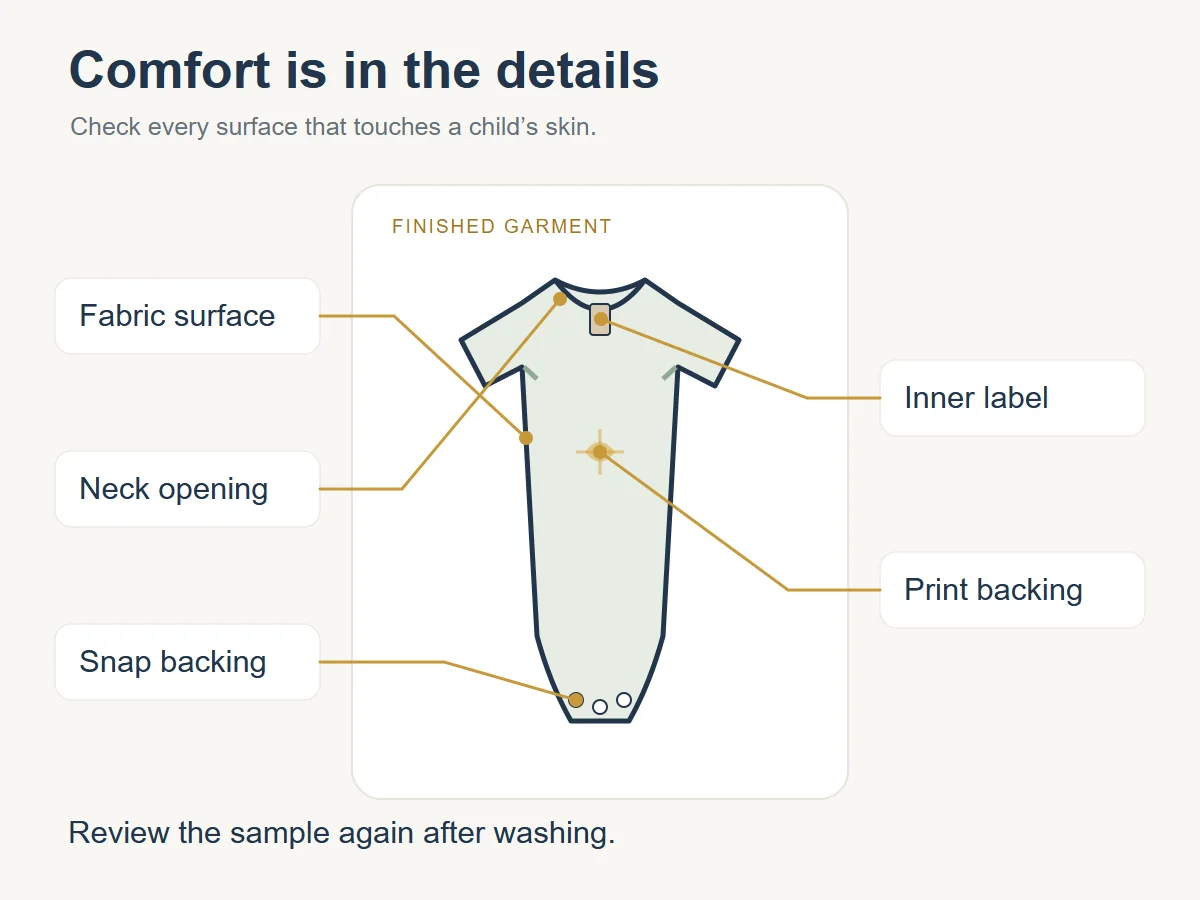
When reviewing a sample, we recommend checking the complete garment rather than relying on a fabric swatch alone:
- Feel both sides of the fabric, including areas with prints or embroidery.
- Run a hand around the neckline, leg openings, and underarm seams.
- Check whether snaps and labels sit comfortably against the skin.
- Try the garment on the intended size range where appropriate.
- Wash the sample using the care method planned for the product, then repeat the checks.
From a product-development perspective, we would not choose organic cotton simply because the label sounds better. The fabric still needs to suit the garment. A baby bodysuit needs comfortable openings and suitable recovery; leggings need the right amount of stretch; a T-shirt needs a neckline that does not lose its shape after washing.
Organic Cotton vs. Conventional Cotton: What Is the Difference?
The clearest difference is the documented growing standard and origin of the cotton. The fiber name alone does not tell you which garment will be softer, last longer, or shrink less. Those results depend on the fabric and how the garment is made.
| What to compare | Organic cotton | Conventional cotton |
|---|---|---|
| Fiber origin | Organic status should be supported by the relevant certification and supply-chain records | No organic-origin claim is implied |
| Softness | Depends on yarn, construction, and finishing | Depends on the same factors |
| Shrinkage and durability | Must be tested on the selected fabric and garment | Must be tested on the selected fabric and garment |
| Processing | Depends on the standard and the certified stages | Depends on the supplier’s specifications and any other certifications |
| Cost | May be higher due to supply, certification, availability, or order details | Varies by quality, construction, and market conditions |
For a fair comparison, use fabrics with similar weight, construction, color, and finish, then make them into the same garment pattern. If you compare a light conventional jersey with a much heavier organic interlock, you are comparing two different fabric constructions—not just organic and conventional cotton.
Does Organic Cotton Have a Smaller Environmental Impact?
Organic certification can support a specific claim about how the cotton was grown. It does not prove that every stage of the finished garment has a lower environmental impact. Water use, energy, dyeing, finishing, transport, and garment life all matter.
Textile Exchange’s 2026 Materials Market Report estimates that around 720,000 tonnes of organic cotton were produced in 2024/25, representing approximately 2.8% of global cotton production. Textile Exchange describes this global figure as a rough estimate because certification systems overlap and data gaps remain. It is useful context for understanding the scale of the market, but it is not a measurement of children’s clothing demand or proof that one finished garment is more sustainable than another.
For brands, the practical lesson is to make claims that match the evidence. If the documentation confirms the organic fiber content, state that clearly. Avoid broad claims such as “chemical-free,” “completely eco-friendly,” or “better for every child” unless there is separate evidence to support them.
Organic Cotton Certifications: What Should Clothing Brands Check?
GOTS, OCS, and OEKO-TEX STANDARD 100 are not interchangeable. They answer different questions, so a brand should decide what it wants to verify before requesting documents.
| Standard | What it helps verify | What it does not prove by itself |
|---|---|---|
| GOTS | Organic fiber content and covered environmental and social requirements across certified textile processing | That every product from a supplier is certified, or that a particular shipment is covered without the required transaction evidence |
| Organic Content Standard (OCS) | Organic material content and chain-of-custody tracking | The broader processing requirements covered by GOTS |
| OEKO-TEX STANDARD 100 | Testing of the certified textile or article against harmful-substance limits | That the cotton was organically grown |
| OEKO-TEX ORGANIC COTTON | Organic cotton origin under that separate scheme | That a STANDARD 100 certificate proves organic origin |
GOTS Version 8.0 was released in March 2026. The one-year transition period runs until 1 March 2027, when the updated standard becomes mandatory for certified entities and approved chemical inputs. Brands developing products now should ask which version their supplier currently follows and how the transition will affect audits, certification scope, and future orders.
How Do You Verify an Organic Cotton Claim?
Start with the certificate, then check whether it covers the supplier, product category, and process involved in your order. A certificate displayed on a website is only a starting point.
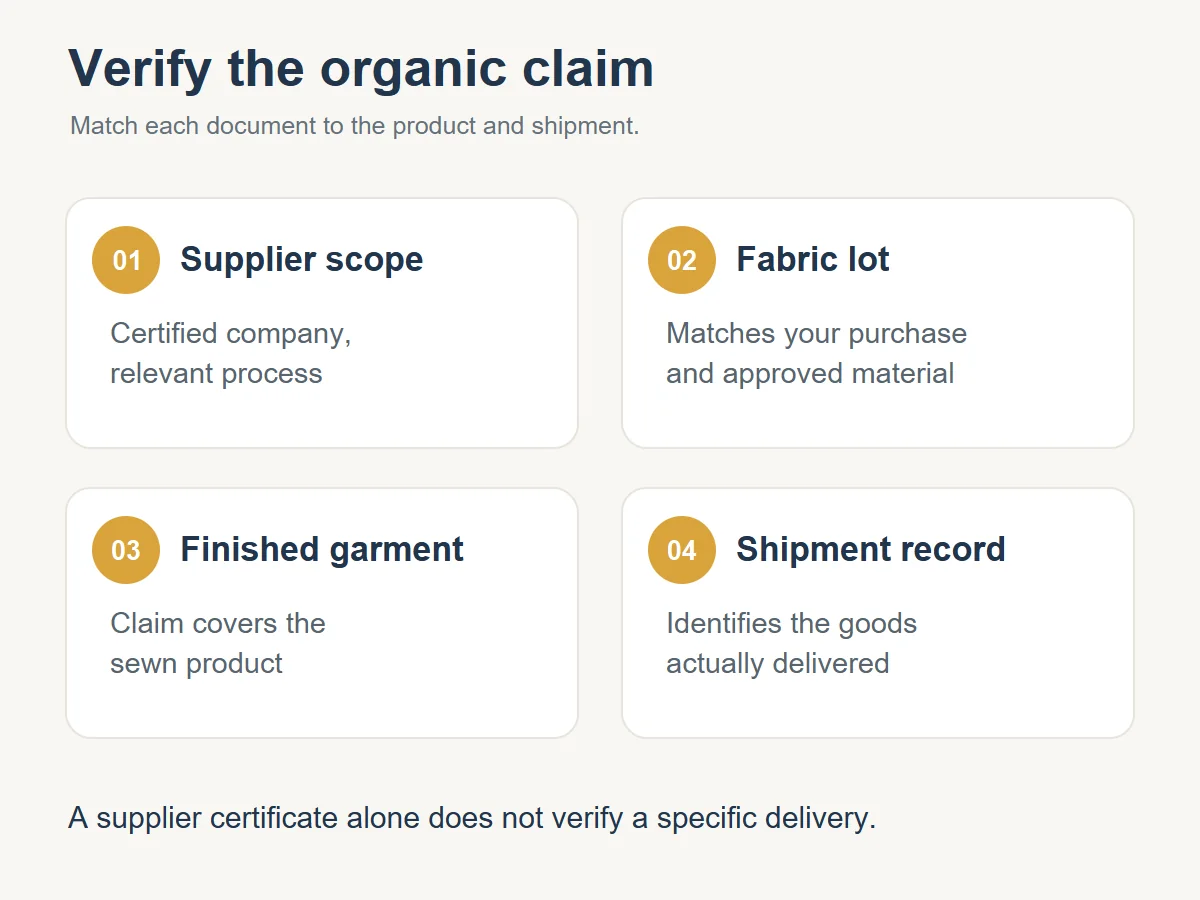
For a GOTS-related order, ask for the current scope certificate and the transaction evidence required for the relevant shipment. Match the company name, product description, quantities, dates, and material details to your purchase. If a supplier provides a certificate for a different facility or product category, it may not support the claim you plan to make.
Also confirm who is responsible for each certified step. A mill may supply certified fabric, while the garment manufacturer or brand may not be covered for the finished product claim. The chain of custody and labeling rules of the chosen scheme determine what can be said about the final garment.
What Documents Should You Request from a Supplier?
Keep the document request focused on the actual order:
- A current scope certificate for the relevant supplier and product or process.
- Transaction certificate or other shipment evidence required by the chosen standard.
- Fabric composition, weight, construction, and color specification.
- Purchase, lot, and production records connecting the certified fabric to the finished style.
- Approved label or hangtag artwork if the brand plans to use a certification mark or organic claim.
Check certificate dates, numbers, company names, product descriptions, and quantities. Keep the records with the tech pack and purchase order so the same checks can be made for repeat orders.
What Can You Say on a U.S. Product Label?
Use wording that matches the certification and the finished product. The USDA explains that textiles meeting GOTS may be sold as organic in the United States. However, unless the finished product is certified under USDA organic regulations, the label must not imply that the finished textile is USDA organic or use the USDA organic seal.
Keep organic-fiber claims separate from required fiber-content, care, and country-of-origin information. If you plan to use a certification logo or a scheme-specific phrase, confirm the wording and artwork with the relevant certifier before printing labels or packaging.
Which Children’s Clothes Work Well with Organic Cotton?
Organic cotton can be used across many children’s clothing categories, but the fabric construction should match the garment. A soft jersey may suit a T-shirt; interlock may work for a fuller bodysuit; rib can add stretch to cuffs or necklines; French terry can be used for sweatshirts and joggers. These are starting points, not fixed recipes.
| Garment | Possible fabric choice | What to check in the sample |
|---|---|---|
| Baby bodysuit or romper | Jersey, interlock, or rib | Neck opening, snap placement, seams, and wash performance |
| T-shirt or top | Single jersey or interlock | Opacity, neckline recovery, print feel, and shrinkage |
| Leggings | Stretch knit or a suitable blend | Waistband recovery, knee shape, and stretch |
| Sweatshirt or joggers | French terry or brushed knit | Weight, rib recovery, pilling, and wash performance |
| Woven shirt or dress | Poplin, lawn, or another suitable woven fabric | Drape, coverage, creasing, and care requirements |
At Shimmerella, fabric selection is considered alongside the intended style, fit, and construction. A fabric that works well for a baby bodysuit may not be the best option for leggings or a sweatshirt. The sample should show how the fabric behaves in the actual garment, not just how it feels as a swatch.
We also avoid treating “100% organic cotton” as a universal specification for every category. For a T-shirt, a cotton jersey may be a practical starting point; for leggings, the brand may need a blend with more stretch and recovery. Our recommendation is to define the garment’s performance needs first, then confirm which fiber content and certification wording can accurately support the product.
Is 100% Organic Cotton Always the Best Choice?
No. Some garments need more stretch or recovery than a particular 100% cotton fabric can provide. A blend may work better for leggings, fitted waistbands, or rib trims, depending on the design.
The important point is to describe the fiber content accurately and make sure any organic claim follows the relevant standard. If a garment includes elastane, elastic, lining, thread, or decorative components, check how those parts affect the certification and labeling scope. Do not assume that a certified main fabric makes every component or the entire garment certified.
Can Organic Cotton Be Used for Children’s Pajamas?
Yes, but organic certification does not replace U.S. children’s sleepwear requirements. The applicable rules depend on the garment’s intended use, size, fit, and construction. Brands should review the finished pajama style against the relevant CPSC sleepwear requirements before approving the sample and labels.
For a sleepwear project, confirm the product classification, required testing, measurements, and labeling with a qualified testing partner. A cotton or organic-cotton description alone does not determine whether a pajama style meets the applicable requirements.
How Should Brands Test Organic Cotton Clothing Before Production?
Treat a fabric swatch as a starting point. The finished garment—including seams, trims, prints, and labels—needs to meet the agreed specification. Organic certification does not tell you whether the neckline will recover, the color will stay stable, or the garment will keep its measurements after washing.
The right checks depend on the product. Common areas to review include:
- Dimensional change after the agreed wash and drying process.
- Colorfastness to washing and rubbing.
- Pilling and surface appearance.
- Stretch and recovery for rib, cuffs, waistbands, and fitted garments.
- Seam appearance, opening strength, and print or embroidery feel.
- Finished measurements before and after care.
How Can You Compare Two Fabric Samples Fairly?
Keep the garment pattern, size, color, print, care cycle, and measurement points consistent. Record the fiber composition, construction, weight, and finish for both fabrics before testing. Then make the samples into the same style and wash them under the same conditions.
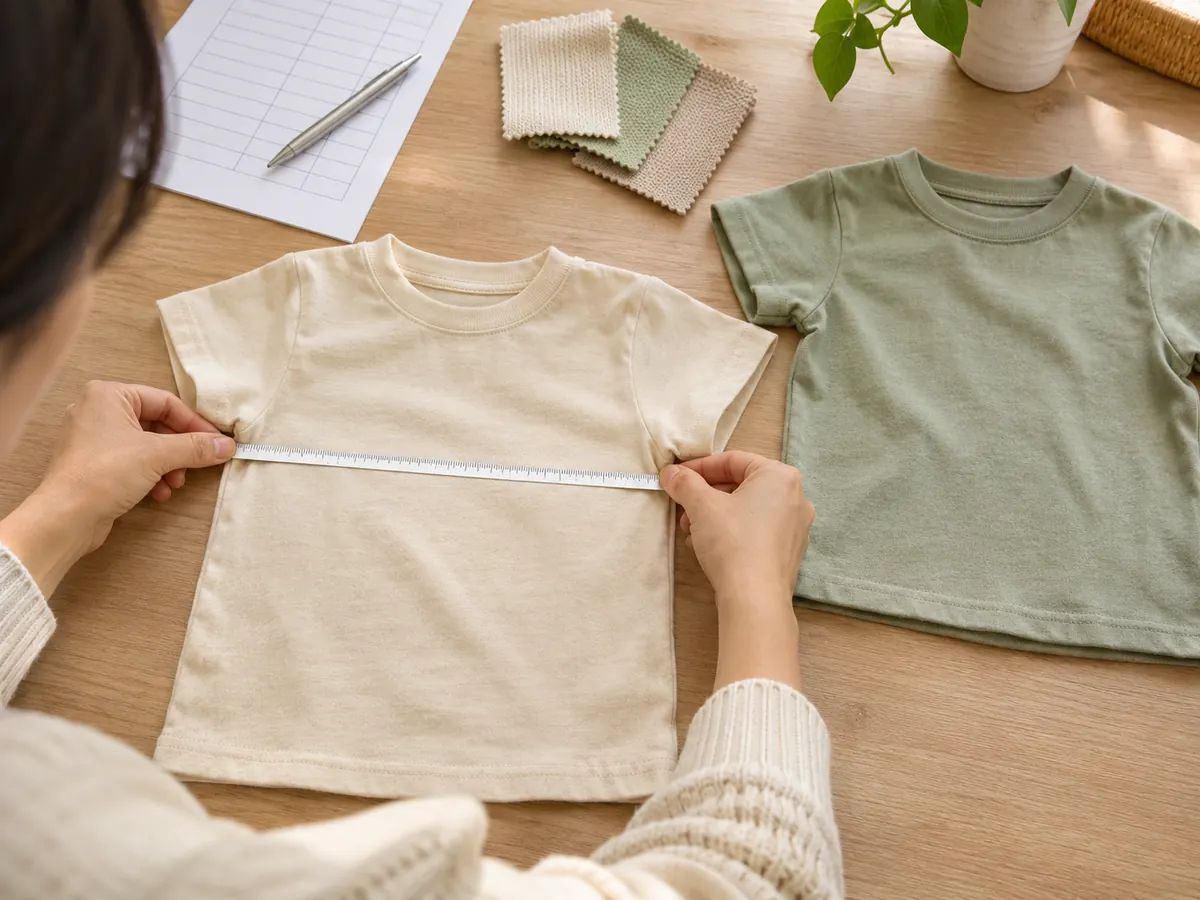
After washing, compare body length, width, sleeve length, neckline shape, twisting, seam puckering, color change, and hand feel. Photograph both samples under the same lighting and keep the approved reference beside them. This helps the team decide based on the garment’s actual performance rather than the feel of an unwashed swatch.
When we compare fabric options, we prefer to keep the pattern and care conditions consistent and record the measurements before and after washing. That makes it easier to see whether a change comes from the fiber, the fabric construction, or the finishing. If those variables change at the same time, the comparison is much less useful.
How Do You Keep Bulk Production Consistent?
The approved sample should be linked to a written fabric and garment specification. Record the fabric supplier, composition, construction, weight, color reference, finish, trims, measurements, and agreed test requirements.
Before bulk cutting, confirm that the production fabric matches the approved material. If the supplier proposes a substitute, review its effect on fit, washing, color, price, and certification before approving the change. For repeat orders, check the new fabric lot and supporting documents again. A similar-looking fabric is not automatically the same material or covered by the same certification.
Is Organic Cotton Worth the Extra Cost?
It can be worth paying more when verified organic content matters to the collection and the finished garment still meets the brand’s comfort, quality, and price goals. The added cost may come from fiber sourcing, certified processing, availability, documentation, or order quantity. The actual difference depends on the fabric and supplier.
Before choosing the more expensive option, ask:
- Is the organic claim important to the customer and supported by the documents?
- Does the fabric still meet the garment’s fit, comfort, and wash requirements?
- Can the supplier provide the same approved material for bulk production and reorders?
- Does the final garment cost still leave room for the brand’s target retail price?
Our view is that brands should not choose organic cotton only because it sounds more premium. When we discuss fabric choices with a brand, we look at the complete decision: how the garment should feel, how it will be washed, whether the supplier can maintain the same material, and whether the paperwork supports the planned claim. The right fabric is the one that meets the product’s needs, can be sourced and documented consistently, and supports a claim the brand can stand behind.
If organic content is a firm requirement, include the certification scheme, fiber percentage, required documents, and substitution rules in the tech pack and purchase order. Shimmerella’s babywear development team can help brands discuss fabric options and turn a product brief into a sample for review. You can also explore our children’s clothing fabric guide.
Frequently Asked Questions
Is organic cotton always softer than regular cotton?
No. Softness depends on yarn quality, fabric construction, weight, and finishing. Compare finished garments made to the same pattern and check how they feel after the intended washing process.
Is organic cotton hypoallergenic?
Organic certification does not mean a garment is hypoallergenic. Dyes, finishes, seams, labels, and a child’s individual sensitivities can all affect comfort. Avoid medical or allergy-related claims unless you have evidence for the finished product.
Does 100% cotton mean the fabric is organic?
No. “100% cotton” describes fiber composition, not how the cotton was grown. An organic claim needs relevant certification and supply-chain documentation.
What is the difference between GOTS and OEKO-TEX STANDARD 100?
GOTS covers organic fiber content and specified textile-processing requirements across a certified supply chain. OEKO-TEX STANDARD 100 tests a textile or article against harmful-substance limits. A STANDARD 100 certificate does not prove that the cotton was organically grown.
Does organic cotton shrink after washing?
It can. Shrinkage depends on the fabric construction, finishing, and care method, not simply whether the cotton is organic. Test the finished garment using the care instructions planned for customers.
Can organic cotton be blended with elastane?
Yes, but the fiber percentages and certification claim must reflect the actual composition and the rules of the chosen standard. Check whether the blend and other components are covered before making a claim about the finished garment.
Can organic cotton be used for children’s pajamas in the U.S.?
Yes, provided the finished sleepwear meets the applicable U.S. requirements. Organic status does not replace sleepwear classification, flammability, testing, or labeling rules. Confirm the style and size with a qualified testing partner.
Is organic cotton worth the higher price for a children’s clothing brand?
It depends on the product, customer, and documentation. It may make sense for a collection built around traceable materials, but the fabric still needs to perform well and fit the target retail price. Compare the complete garment and supply-chain cost, not just the price per yard.