Sourcing custom children’s winter clothes starts with more than choosing a warm fabric. A fleece jacket for school, a padded coat for everyday cold weather, and a snow-focused outer layer need different construction, fits, and production plans. For a clothing brand, these choices also affect cost and the date stock reaches the warehouse.
The practical route is to define the collection, find a capable manufacturer, compare materials and quotations, approve samples, confirm U.S. requirements, and plan bulk production. Unlike ready-stock wholesale, custom manufacturing gives your brand control over selected details—but those decisions must be agreed upon before production.
Your six-step sourcing plan:
- Define each style’s use, age range, size mix, target price, and warehouse date.
- Find manufacturers with experience in the type of winter clothing you want.
- Compare fabrics, customization options, minimum orders, and complete quotations.
- Review the physical sample, then approve the version intended for bulk production.
- Confirm applicable U.S. safety, testing, labeling, and product-claim requirements.
- Set production checks, delivery milestones, and realistic reorder conditions.
Define Your Winter Clothing Collection
Before asking for a quote, decide what your winter range needs to do. The climate, activities, and layers children will wear underneath should influence the garment more than a general description such as “thick” or “warm.”
Choose Styles Based on Climate and Use
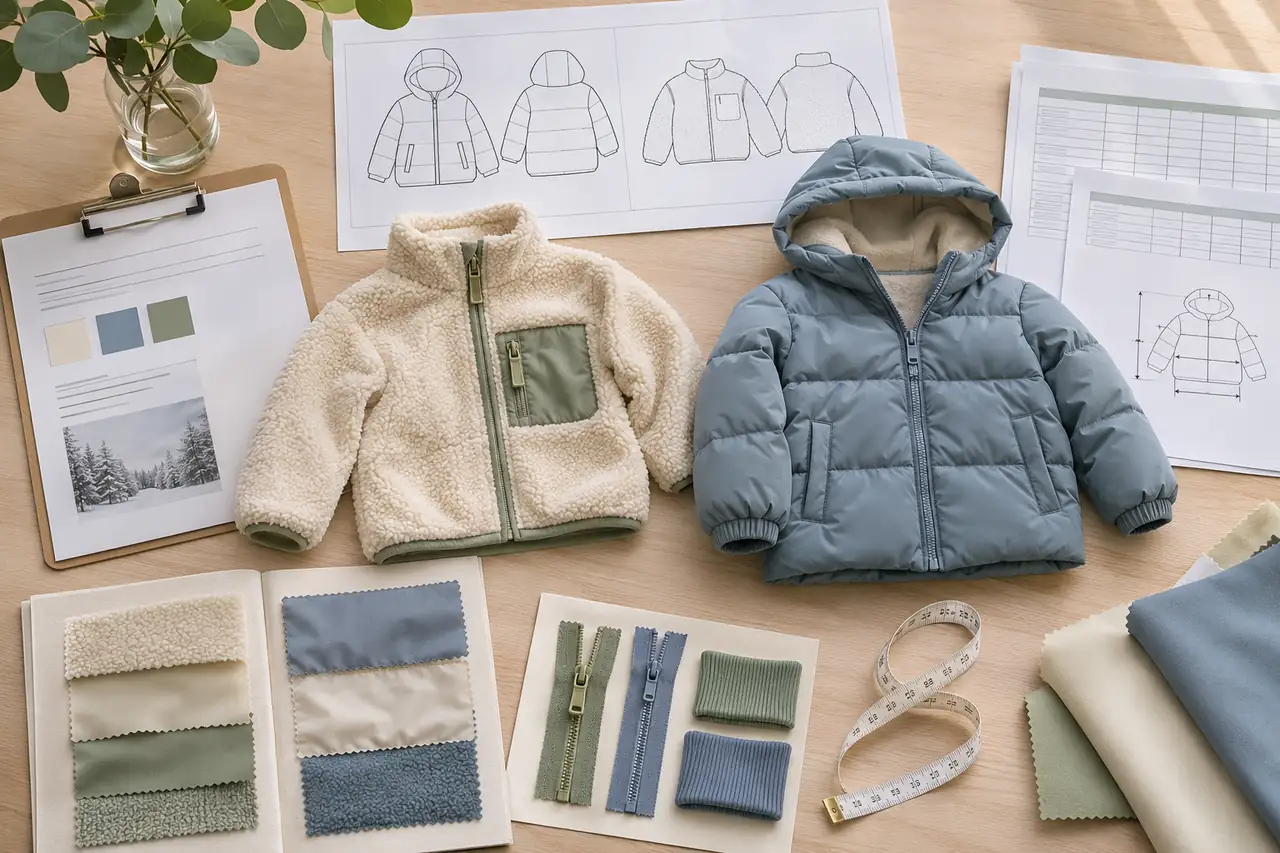
A fleece layer can work for everyday transitions between indoors and outdoors. A padded jacket adds decisions about its shell, lining, filling, and coverage. Snow-focused outerwear may call for more demanding water-protection details and evidence of performance; confirm whether a supplier actually makes that category before including it in your order.
| Winter style | Best starting point | What to confirm before development |
|---|---|---|
| Fleece jacket | Everyday layering and cool-weather use | Surface feel, fit beneath an outer layer, collar, cuffs, and wash care |
| Padded jacket | Daily cold-weather outerwear | Shell, lining, filling, hood, closures, and room for a sweater |
| Snow-focused outer layer | Extended activity in wet or snowy conditions | Intended weather protection, seam and closure construction, and finished-garment testing needs |
These are product-planning categories, not promises of specific warmth ratings. A fabric name or weight alone cannot establish the performance of a finished jacket.
For a new winter collection, we would not add more insulation simply to make a jacket feel thicker. A child wearing it to school still needs to sit, lift their arms, and manage the zipper. Start with the weather and layering plan, then choose the materials and construction that fit that use.
Keep Your First Collection Focused
List the styles, colors, age groups, and size quantities you plan to launch. Every additional fabric color, trim option, or pattern may introduce a separate minimum order or material commitment. Confirm the warehouse arrival date, not just the day you want production to finish.
For the first season, we recommend prioritizing a small number of well-defined core styles over extra color options that are difficult to reorder. If a style may return next winter, ask whether the same fabric, zipper, and lining can be sourced again.
Find the Right Kids’ Winter Clothing Manufacturer
A suitable kids’ winter clothing manufacturer should be able to explain how it develops the exact garment you want. A company selling finished jackets from stock is not necessarily able to create your pattern or control the components of a private-label collection.
Where to Look for Manufacturers
Use a few channels rather than relying on one broad search:
- Specific Google searches: Try “custom kids fleece jacket manufacturer,” “children’s padded jacket manufacturer,” or “private label kids’ winter wear.”
- Manufacturer websites: Check whether the company shows construction details, customization options, and comparable products rather than only catalog photos.
- Trade shows and showrooms: Review physical samples and discuss fabrics, fit, and development needs with the team.
- Industry directories and supplier referrals: Use fabric or trim suppliers to identify factories familiar with the materials you have chosen.
When you contact a supplier, ask whether it offers ready-stock wholesale, changes to an existing design, or complete OEM/ODM development. Those are different services with different levels of control.
Check Who Makes the Sample and the Bulk Order
Ask who prepares the pattern, sources the shell and lining, makes samples, and cuts and sews the garments. Confirm whether any operations are subcontracted and whether sample development and bulk production take place at the same facility.
Shortlist manufacturers using five checks:
- Comparable fleece or padded jackets they can show you.
- Responsibility for pattern making, sampling, and production.
- Access to the required fabrics, insulation, zippers, and trims.
- Documents supporting any testing or certification claims relevant to your style.
- A clear contact who can approve changes and resolve defects.
A U.S. office or showroom can make communication and sample review easier, but it does not prove that a garment is made in the United States. Confirm the location of the actual manufacturing steps whenever origin matters to your brand.
Compare Fabrics and Manufacturing Costs
Two quotes are only comparable when they cover the same garment. Before evaluating the unit price, agree on materials, construction, branding, sizes, and the work included in the price.
Specify Fabrics, Construction, and Branding
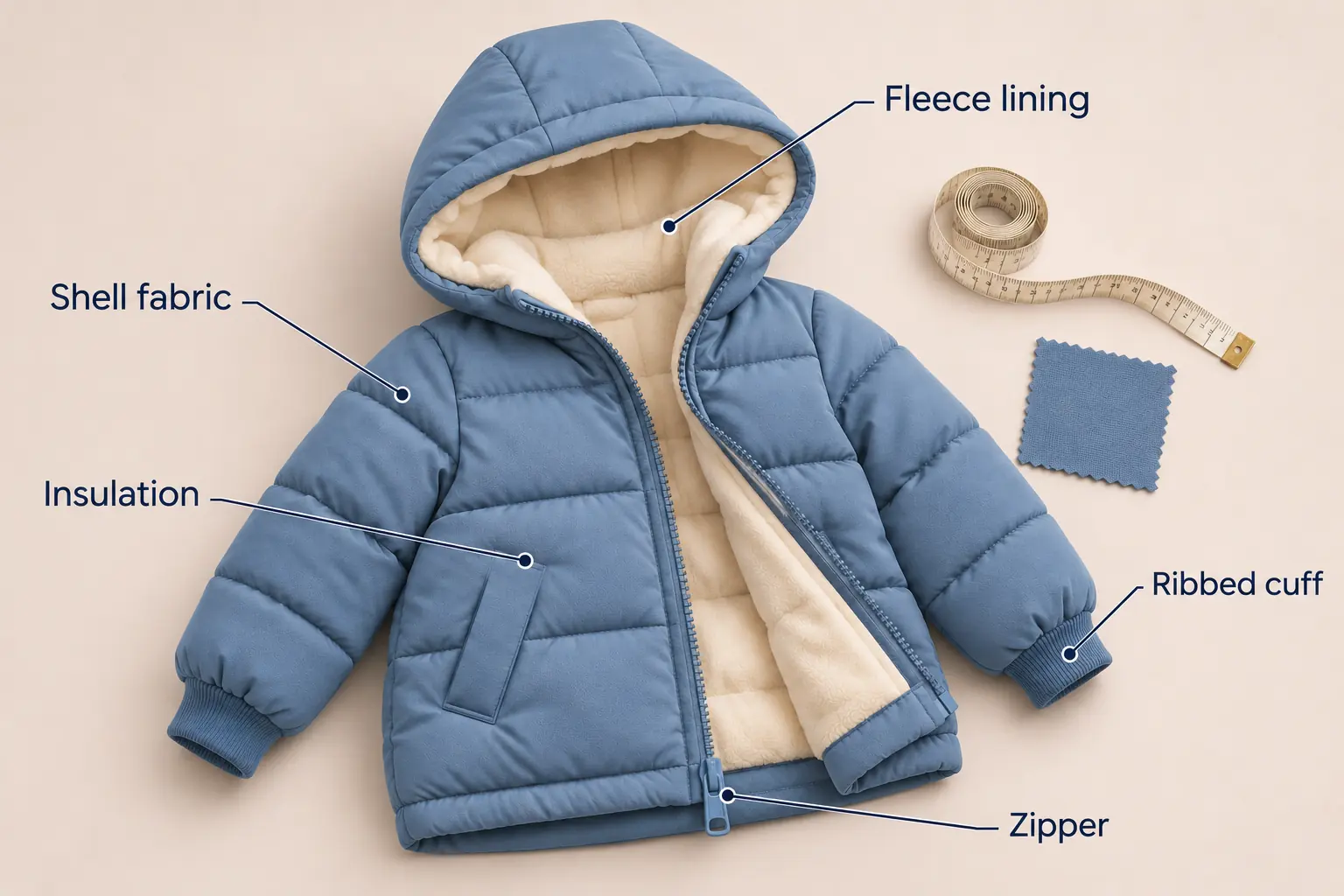
For fleece, compare weight, surface feel, collar shape, cuffs, and how the jacket fits under another layer. For padded jackets, specify the outer shell, lining, filling, quilting, hood, pockets, and closure. Review how each component affects care, comfort, and the finished look.
If you are considering recycled polyester for fleece, linings, or other components, be specific about what you are buying. Textile Exchange’s 2026 Materials Market Report estimates that polyester accounted for 59% of global fiber production in 2025, while recycled polyester made up about 12% of polyester production. These are global fiber figures, not children’s winterwear usage rates or a guarantee of supply. Ask for the actual fabric composition, supporting records, and bulk availability before approving a recycled-content claim.
Customization may also include prints, embroidery, patches, labels, hangtags, and packaging. Place artwork, dimensions, and decoration positions in the tech pack. Check decoration on the intended material; embroidery backing that looks neat in a photo may feel rough against a child’s skin.
Shimmerella’s custom kids’ jacket service includes fleece and puffer jacket development, with options for fabrics, linings, closures, and brand details. Confirm project-specific materials and technical features before treating them as approved production capabilities.
A useful tech pack does not need to be complicated, but it should identify the current approved version. Include:
- Front and back sketches or a reference garment.
- Size range, measurements, and grading requirements.
- Shell, lining, filling, trims, and care expectations.
- Artwork, labels, and packaging instructions.
- Open decisions, revision date, and target warehouse arrival date.
For additional material background, see our guide to choosing fabrics for kids’ clothing. The final choice should still be checked on the actual winter garment.
Compare MOQs and the Full Quote
Send each shortlisted supplier the same request for quotation (RFQ). Ask them to list what is included and what will be charged separately. A lower unit price may come with higher commitments to fabric, colors, or special trims.
| Quote item | What to ask |
|---|---|
| Development | Are patterns, size grading, sample rounds, and revisions included? |
| Minimum order quantity (MOQ) | Does the minimum apply per style, color, fabric, or total order? Can sizes be mixed? |
| Materials | Are the approved shell, lining, filling, and trims available for the full order? |
| Testing and finishing | Who pays for required tests, labels, packaging, and any retests? |
| Delivery and reorders | Where is the price delivered, when does the schedule start, and what are the reorder terms? |
Price uncertainty is another reason to compare the whole order. In the 2026 USFIA Fashion Industry Benchmarking Study, 92% of surveyed executives placed U.S. protectionist trade policies and related uncertainty among their two biggest business challenges. The survey covered 30 major U.S. fashion businesses, not a representative sample of small kidswear brands. For your own order, ask which charges and delivery assumptions could change after the initial quote.
We would then compare the total money committed, not only the cost per jacket. A cheaper unit price can be the wrong choice if the minimum order leaves too much cash tied up in fabric or finished stock that may not sell before winter ends.
Review and Approve Winter Clothing Samples
The sample should answer one question: can the finished garment meet your design, fit, care, and use requirements? A good-looking photo or a fabric swatch cannot settle that on its own.
Check Fit Over the Intended Layers
Try a fleece or jacket over the clothes children are expected to wear underneath. Check shoulder movement, sleeve length, hem coverage, hood fit, and whether the child can manage the zipper. A jacket that fits over a T-shirt may be too restrictive over a sweatshirt.
We would treat the smallest and largest planned sizes as separate sample checks, rather than assuming the middle size will scale correctly. A hood that fits the base size may be too deep on a smaller child; a larger size may need different sleeve coverage over a sweatshirt. Check the pocket and zipper positions at both ends of the range, too.
For a padded jacket, movement and independent dressing matter as much as appearance. Record the measurement, photograph, or construction change needed, rather than sending the factory a vague note to “improve the fit.”
Check Construction, Care, and the Approved Version
Examine the actual shell, lining, filling, cuffs, zippers, seams, decoration, and labels. Follow the intended care instructions on a review sample and record any relevant changes to appearance or measurements. For performance claims such as water resistance, agree on the testing method and whether evidence concerns the fabric or the finished garment.
Before bulk production, keep a clear approval trail:
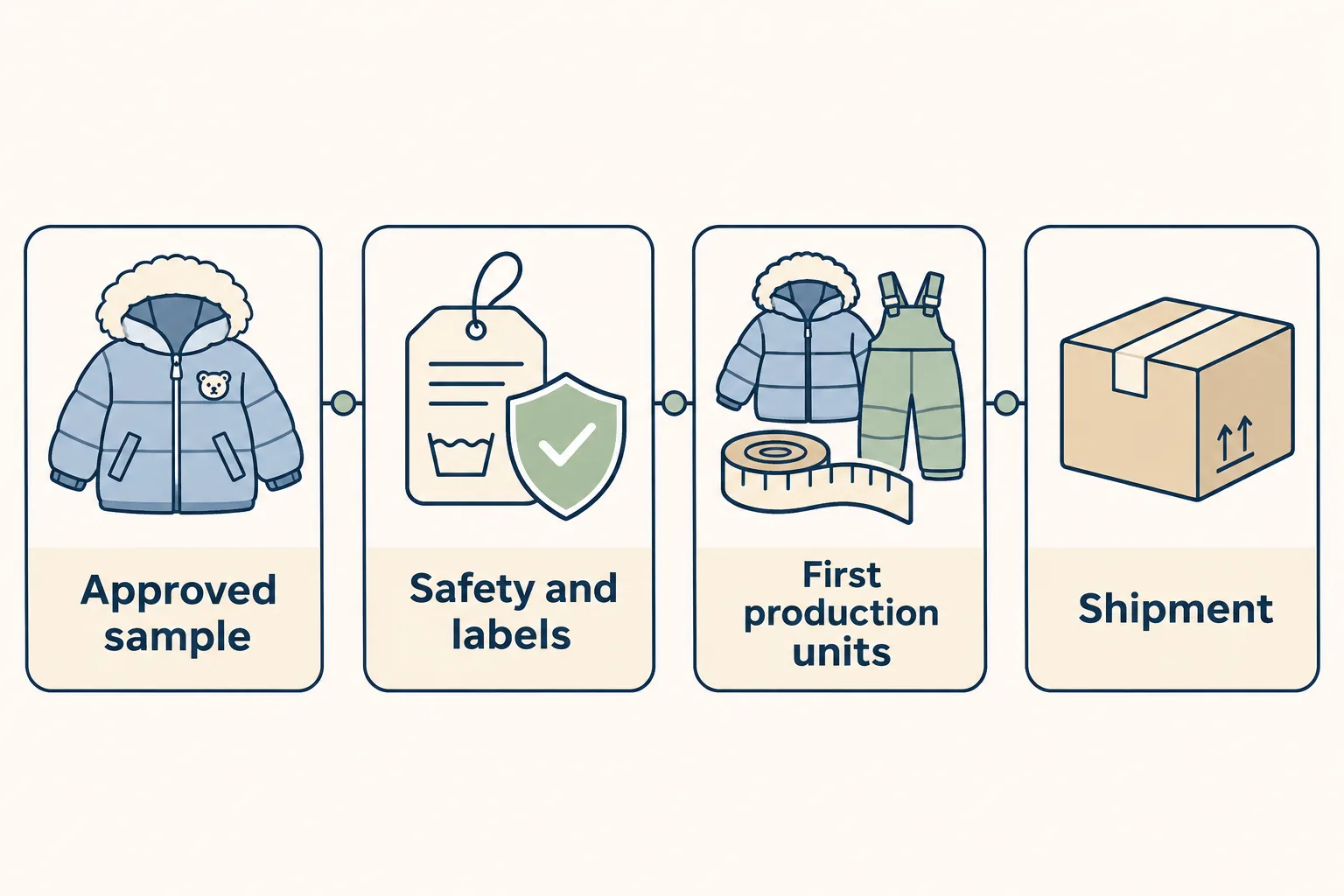
Approved sample → final tech pack and materials list → pre-production confirmation → first bulk-unit checks.
Record the sample version, measurements and tolerances, material references, artwork, and permitted substitutions. If a sample uses a stock fabric, obtain separate approval for the material actually ordered for bulk. This is where a small difference in fabric or ribbing can become a much larger problem across an entire run.
Check U.S. Safety and Labeling Requirements
For winter clothing sold in the United States, compliance depends on the garment, its features, and the children it is intended for. Check the relevant rules early enough to change a hood, closure, or label before production.
Review Outerwear Safety and Testing
The U.S. Consumer Product Safety Commission (CPSC) identifies hood and neck drawstrings on children’s upper outerwear in sizes 2T–12 as a substantial product hazard. Waist and bottom drawstrings on outerwear in sizes 2T–16 have separate limits. Some sweatshirts worn as outerwear are covered too.
For children’s products subject to applicable safety rules, confirm the required testing and Children’s Product Certificate (CPC). The responsible domestic manufacturer or importer generally issues the CPC; a testing laboratory supplies results, not the certificate. Applicable exceptions and testing details depend on the product and rule. Plan any required tracking information alongside the label and production records.
Check Labels and Product Claims
The FTC’s textile-labeling guidance explains requirements involving fiber content, origin, and responsible business identification for covered products. Check applicable care-label instructions as well.
Descriptions such as “waterproof,” “warm to 0°F,” or “Made in USA” need evidence for the actual product. Do not use a showroom location, a fabric supplier’s claim, or a generic factory certificate as proof of a finished garment’s performance or origin.
For a fuller checklist, see our guide to U.S. children’s clothing requirements.
Plan Your Winter Clothing Production
Production planning should start with when the stock must reach your warehouse, not when the factory says sewing will finish. Winter collections have a limited selling window, so the timeline and the reorder plan matter together.
Work Backward from the Warehouse Date
Allow time for final sample approval, fabric procurement, any required testing, production booking, cutting and sewing, inspection, shipping, and receiving. Ask the factory when its stated lead time begins: after a deposit, sample approval, material arrival, or a confirmed production slot.
Before issuing the purchase order, confirm:
- Approved style, sample, material list, and tech pack version.
- Quantity by color and size, unit price, and payment terms.
- First-unit and in-process inspection points, including who approves changes.
- Packaging, shipping responsibilities, and required warehouse date.
- How defects, late changes, or material shortages will be handled.
Check the first units made from actual bulk materials against the approved sample. Include sizes at both ends of the range where practical. Keep inspection notes and any approved changes with the order records.
Plan Reorders Before the First Order Ships
A winter reorder is only useful if it can arrive while customers still need the product. Ask whether the original fabric and trims will remain available, whether only sold-out sizes can be reordered, and how the minimum quantity and production slot change for a repeat order.
For winter reorders, look beyond the headline production time. Include material availability, transport, warehouse receiving, and the remaining selling weeks. Not every fast-selling jacket should be reordered: if the new stock would arrive near the end of the season, it may be wiser to hold the design and reserve suitable materials for next winter than to create leftover inventory this year.
If you are preparing a winter collection, share your brief with Shimmerella. Send the intended style, target age and sizes, fabric direction, branding, estimated quantity, destination, and required arrival date. We can discuss the development, sampling, and production options relevant to your design.
Frequently Asked Questions
These are the practical questions to settle before requesting samples or placing a custom winterwear order.
What Is the Difference Between Ready-Stock Wholesale and Custom Winterwear?
Ready-stock wholesale means buying an existing product. Custom development allows you to specify or modify details such as fit, fabric, construction, and branding. Ask the supplier which decisions you can control and which are fixed.
Can I Start Without a Finished Tech Pack?
Yes, if the manufacturer provides design-development support. Start with sketches, reference garments, intended use, age range, estimated quantity, and target price. Complete the materials, measurements, and labels before approving bulk production.
What Parts of a Kids’ Winter Jacket Can Be Customized?
Depending on the manufacturer and style, you may be able to change the shell, lining, filling, colors, hood, cuffs, pockets, closures, embroidery, labels, and packaging. Confirm each option against your budget, quantity, and sample before assuming it can be produced.
Can I Mix Sizes and Colors in One Custom Winterwear Order?
Often, sizes can be combined within an approved style, but color and fabric minimums may apply separately. Ask for the MOQ per style, color, and material, plus any required size breakdown, before finalizing your assortment.
Does an Approved Sample Guarantee the Same Bulk Materials?
No. Record the approved sample and material references, then confirm the actual fabric, insulation, and trims ordered for bulk. Review the first production units before assuming the full run matches.
What Affects the MOQ for Custom Children’s Winter Jackets?
The design, fabric availability, color requirements, filling, special trims, and factory production minimums can all affect MOQ. The minimum for a particular fabric may be different from the minimum number of finished garments.
How Early Should I Start Sourcing Winter Clothes for My Brand?
Work backward from the date your warehouse needs the stock. Include sampling revisions, material procurement, testing where applicable, production, inspection, and transit. Request a schedule for your actual design rather than relying on a general lead-time promise.
What U.S. Safety Checks Apply to Kids’ Winter Outerwear?
Check the outerwear drawstring requirements, any applicable children’s product testing and CPC obligations, tracking information, and textile and care labels. Requirements depend on the style and age range; confirm them for the finished product before placing the order.